Why Structural Graph Steering Outperforms Prompt Iteration for Agent Precision
Graphs let agents query architecture instead of interpreting prose.
Sponsored by Graphide
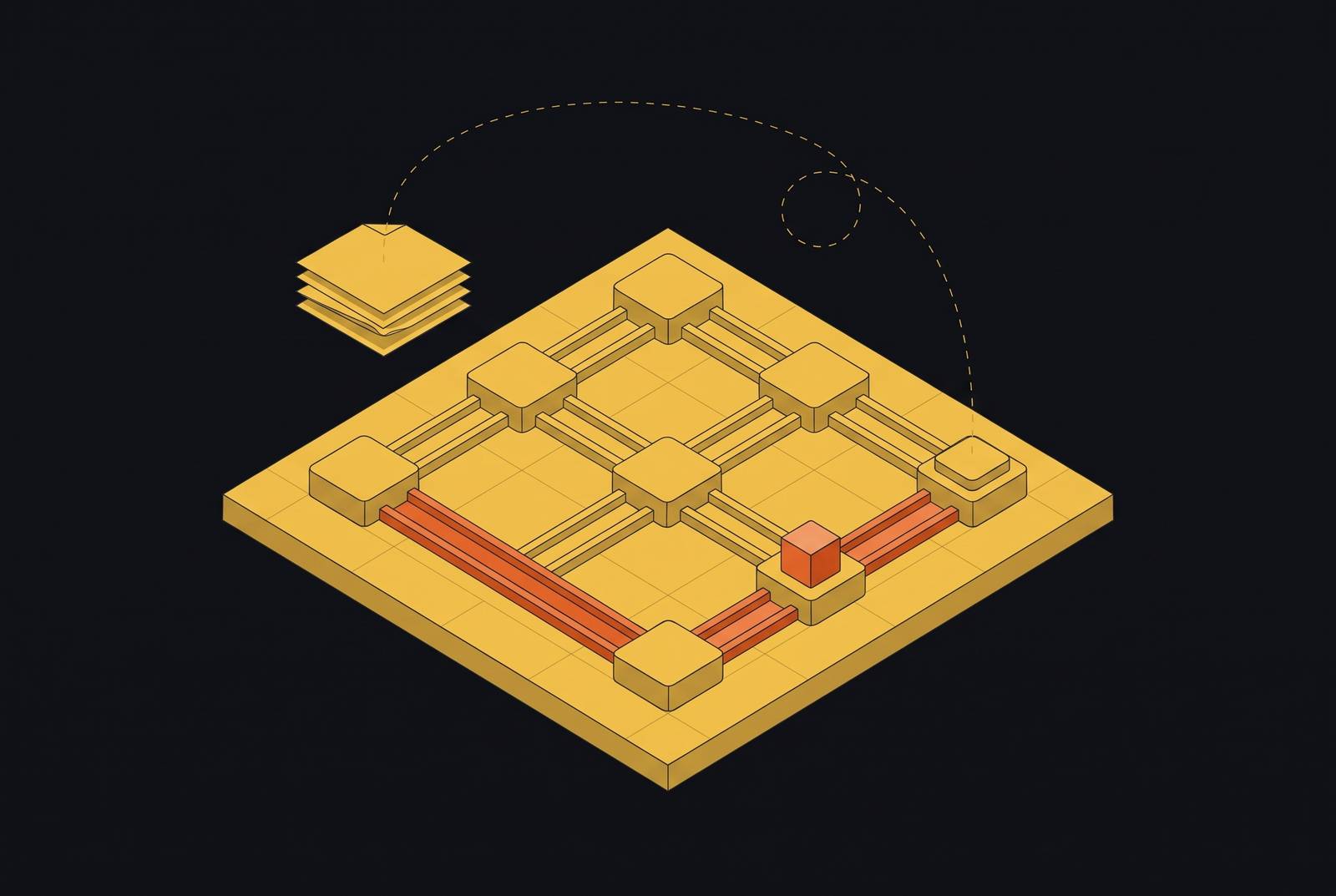
An interactive codebase graph for AI agent steering gives agents a queryable map of code relationships, architectural boundaries, and linked design context. Structural graph steering outperforms prompt iteration because it moves those relationships out of prose the model must interpret and into tools it can query. When the map stays current and its constraints are enforced in CI, architectural precision becomes a property of the development system.
Why agents fail at architecture even when the prompts are good
An agent quietly loses the plot halfway through a task. An agent forgets a constraint stated earlier, takes an approach that makes sense in one place but crosses a forbidden boundary, or says it has succeeded before checking its work. These failures share a mechanical cause. The architecture exists as text inside the same reasoning process that decides what to search, what to change, and when to stop. There may be nothing outside that process to check whether the agent followed the design.
Precise instructions can remove ambiguity, but they cannot enforce architecture. As requirements accumulate, the model must interpret more prose while preserving the relationships among its instructions, retrieved code, and proposed changes. Documentation remains necessary for expressing intent, but a documented boundary is not an enforced boundary.
What constraint decay looks like as a codebase grows
Constraint decay describes performance drops as structural requirements accumulate in a specification. The term is narrower than a general claim that agents forget earlier instructions during long sessions, although that erosion compounds the practical problem. Each new requirement adds a condition the agent must meet as it does the task. In a single-agent loop, judgments about search coverage, sufficient evidence, and completion remain inside the model’s reasoning. Their completeness is difficult to verify from outside.
The agent processes tokens and can read a rule without retaining why the organization adopted it or which failure the rule prevents. As new context arrives, earlier constraints compete with the evidence at hand for the edit. That competition is harder to manage when architectural requirements reach across components. A patch can look right in the retrieved files while breaking a relationship described elsewhere in the prompt.
In the legacy-webhook example, an agent correctly refactored a slow function but removed a try/catch block whose comment read “don't remove — handles malformed JSON from legacy webhook v1”. The edit lost a safeguard it needed because reading the comment did not give the agent a way to enforce the dependency behind it.
More context would not, by itself, repair that failure. The missing capability is a representation that connects the safeguard to its purpose and exposes the connection to checking. Prose can describe such a relationship, but the description alone gives the agent no structural query or gate to keep it from breaking that relationship.
What a code graph actually represents and why it does not decay
A code graph represents entities and their connections with explicit types. An edge can record that service A calls service B over an API, rather than assigning the two services a similarity score. A useful graph represents the entities and relationships, the system-level structure they form, and the context explaining why that structure exists. Its recorded connections do not depend on the model remembering an earlier paragraph.
This differs from both text search and embeddings-based retrieval. Grep finds textual matches, while embeddings RAG retrieves chunks according to similarity. When code is chunked along line boundaries, retrieval can split functions mid-body and return related passages without establishing their call chains or architectural boundaries. A graph answers structural questions by using traversal to follow its links. Symbol definitions, callers of a method, consumers of an API contract, and the impact of a proposed change become queries over recorded relationships.
Dataflow mapping does the same for values. Where the graph models their movement, it can trace a payload from an API entry point to the database column that receives it. The files along that path need not resemble one another, so similarity is not a substitute for the connection. The traversal operates over the graph rather than relying on the full architecture fitting inside a context window. This removes the particular dependency on interpreting an expanding prose description.
How agents navigate a graph differently than they navigate prose
The MCP graph-as-tool pattern makes the map available during execution. A graph server exposes query tools, allowing an agent to ask about structure before deciding which files to read. Instead of consuming a static architecture briefing, the agent retrieves a precise subset relevant to its current task. This makes structural steering available across agent harnesses at runtime. The interface changes what the agent can ask.
With the same graph state and structural query, the answer stays the same even when the request around it is worded differently. The model still has to choose an appropriate query and use its results correctly. Once that query is selected, however, caller relationships or contract consumers are not inferred afresh from prose.
RepoAtlas demonstrates a select–project–refresh loop for keeping repository views focused. It selects a task-relevant graph region under a fixed budget, projects it into complementary visual and textual representations, and refreshes the view as exploration changes. RepoAtlas reports a higher resolve rate on a software engineering benchmark while using fewer input tokens and model calls than the strongest multimodal graph baseline.
Formal Architecture Descriptors as Navigation Primitives for AI Coding Agents investigates structured descriptors as a way to reduce undirected codebase exploration. The premise complements graph navigation without making every descriptor a graph. Both approaches give agents clear paths to the boundaries, symbols, and data flows they need. With a task-specific subgraph, an agent can retrieve the types it must implement, interfaces it must satisfy, and patterns in adjacent modules. Those relationships provide evidence for codebase fit beyond whether a patch compiles.
Stripe's Minions show what happens when structural steering replaces prompt precision at production scale
Stripe’s Minions show how structure can guide autonomous work in production. As of February 2026, the agents generated over 1,300 pull requests per week and were responsible for more than one in ten code contributions company-wide. Tasks originate from Slack, bug reports, or feature requests and proceed from a single instruction. Their precision depends on more than that instruction. Blueprints define workflows in code, combining agent skills with deterministic routines.
The blueprints specify how tasks divide into subtasks and which parts an agent or deterministic routine handles. The Minions blueprints are an architectural analogue to graph steering. In both cases, structure lives outside a paragraph the model must reinterpret. Code determines parts of the workflow that do not need model discretion.
Stripe’s Toolshed supplies a shared capability layer through nearly 500 MCP tools. Different agents receive curated subsets relevant to their tasks, rather than unrestricted access to the entire collection. Stripe also applies a “shift feedback left” philosophy. Lint rules that would fail CI are enforced in the IDE or on a git push, allowing agents to encounter failures earlier. Agents receive only two attempts to fix failing tests before the task escalates to a human.
Stripe’s highly structured monorepo and mature internal tooling are preconditions for its unattended workflow. Teams with uneven test coverage or less well-kept codebases have more work to do before they can use these controls. The example establishes the production value of explicit workflows, bounded attempts, and early feedback, rather than a claim that any team can reproduce the outcome by adopting the same instructions.
Why the stale graph is the real risk — and why it does not rehabilitate the prose alternative
A stale graph can mislead more quietly than no graph. An agent may treat an outdated relationship as authoritative precisely because it arrives through a structural tool. If the map does not track commit identity, timestamps, hashes, and provenance, the agent may not know which version of the system its answer describes. Deterministic traversal can return an outdated answer consistently and thereby support a worse change than unaided exploration would have produced.
Production-grade graph steering therefore requires infrastructure for freshness and quality. Deep static analysis supplies deterministic structure first, with semantic summaries added second and human-approved architecture labels where needed. Updates as code and tickets change keep the graph from relying on manual re-indexing. Local refresh paths must also show when data is stale.
A graph cannot recover an undocumented reason merely by indexing code, and the legacy-webhook failure remains possible when that reason is absent. The graph-as-tool pattern partly addresses this by linking tickets, incident history, and design decisions to the functions they shaped. Human context still has to enter the system. These limits call for better graph infrastructure and more linked evidence while leaving prose as only one part of architectural control.
CI enforcement is where graph constraints become non-negotiable guarantees
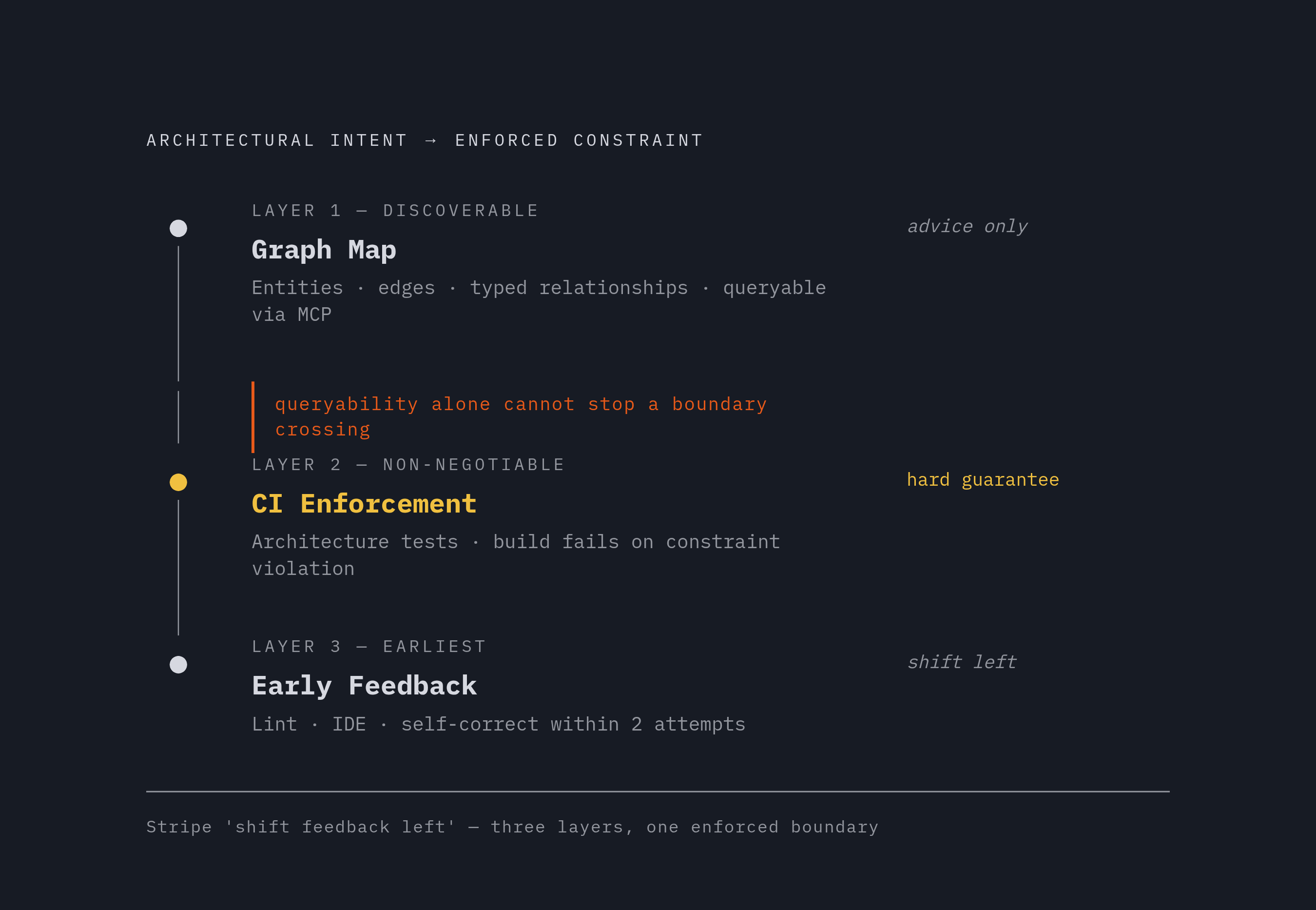
A graph constraint is only advice until breaking it can fail CI. Queryability helps the agent discover a boundary, but it does not stop the agent from generating code that crosses it. Architecture tests provide the missing enforcement layer. They can prevent a violating change from becoming a permanent part of the system even when generation itself cannot be constrained. The guarantee applies to the rules actually encoded and checked.
As agents produce more code, it matters more which rules are actually checked. Human reviewers cannot sustain unlimited vigilance over frequent increments that look mostly right. Small departures from the design can accumulate while each patch appears locally defensible. Structural checks give reviewers explicit violations to inspect rather than requiring them to reconstruct every dependency from the diff. Research on steerability via constraints found substantially higher reviewer recall with a structured substrate compared with prose in a controlled measurement on stratified backdoors.
Open Policy Agent, using Rego, is being embedded in agent-augmented CI/CD pipelines for machine-readable policy enforcement. Cedar’s main role is different: it governs AI agent authorization. These roles should not be conflated. Architectural policy checks and authorization rules govern different parts of the system, even when both make constraints strict, transparent, and traceable. With either, the boundaries still need to be defined correctly.
The graph should stay in the repository, be versioned with the code, and have its constraints made enforceable in CI. Following Stripe’s approach, earlier feedback can then show the same violations before the final gate. The agent gets a chance to fix its work, while CI checks whether the change meets the constraints that would let it go ahead.
How the developer's role changes when the graph, not the prompt, carries architectural intent
Structural steering shifts engineering work from refining instructions to defining the system in which agents operate. Minions automate context gathering, boilerplate, and test execution, while their builders describe their role as engineering the ecosystem in which agents thrive. The responsibility does not disappear. Engineers define the boundaries, curate the graph and its linked context, and decide which violations must block a change.
At the speed agents work in production, checking code line by line is not enough to keep watch over the system. A living map gives engineers a way to navigate relationships and direct attention toward the boundaries affected by a change. Versioning that map with the code and enforcing its policies makes the role concrete.