Multi-Agent Orchestration Patterns for Production Codebases
Picking the right orchestration pattern now prevents costly failures once your system scales.
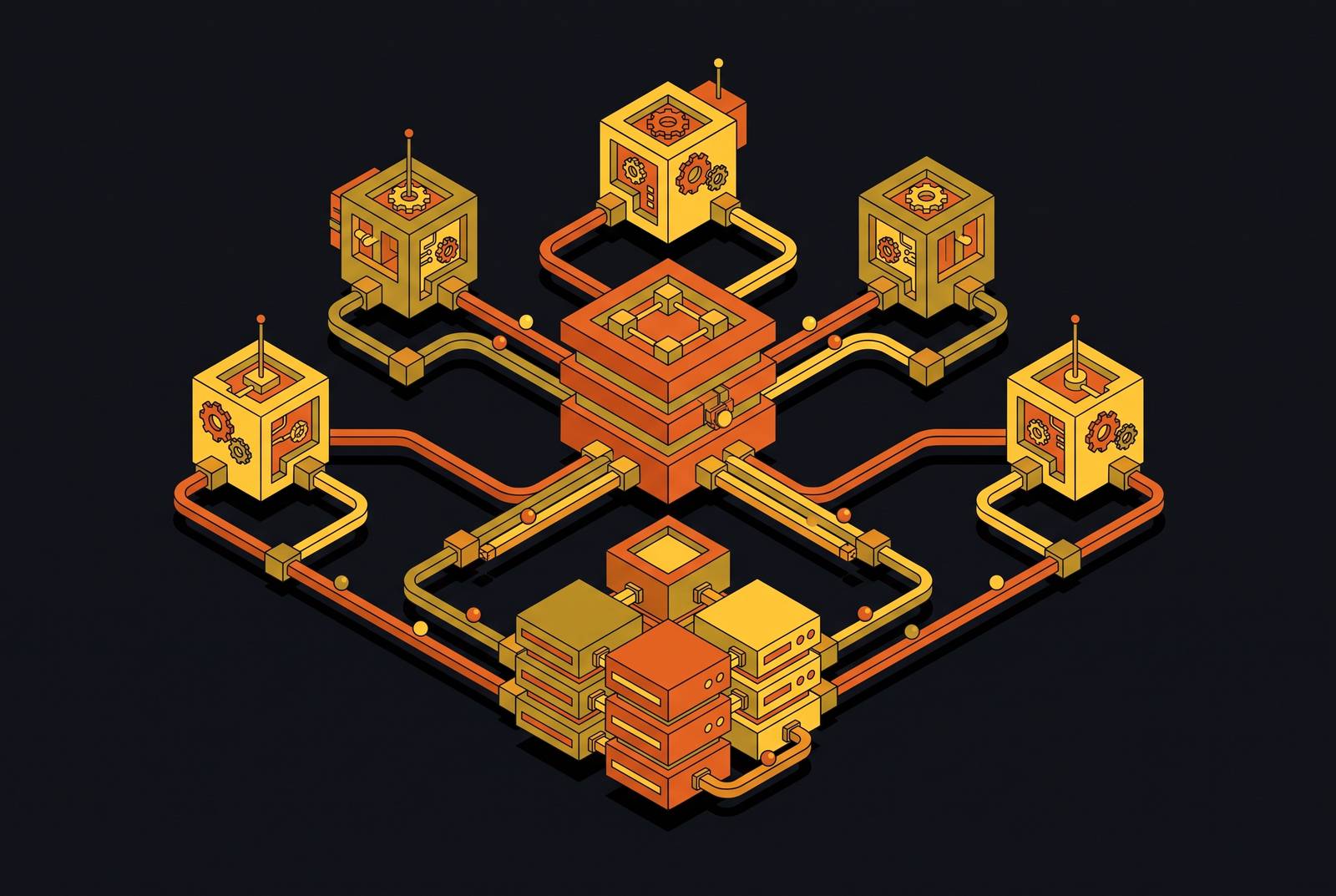
Multi-agent orchestration has become a production engineering problem because the cost of guessing wrong appears on an invoice and in an outage rather than in a benchmark score. The industry has six well-documented orchestration patterns on the table, orchestrator-worker, sequential pipeline, fan-out/fan-in, debate, dynamic handoff, and swarm, and the failure here isn't a lack of options. The failure is that teams pick a pattern the way they'd pick a font, without asking which failure mode comes bundled with it at scale.
Multi-agent orchestration as a production engineering problem
The "God Model" approach, one enormous prompt trying to do everything in a single pass, broke down in production under its own weight. Latency climbed, hallucination compounded across turns, and reasoning failures grew with task complexity rather than staying fixed as model capability improved. The industry's answer was structural: split the work across specialized agents, each confined to a bounded context window and a narrow task, instead of routing everything through one model trying to hold the whole problem in its head. That answer works, but it introduces a new category of risk that didn't exist when there was only one model to reason about. Beam.ai's 2026 production analysis found that roughly two in five multi-agent pilots fail within six months of deployment, and the cause isn't that agents can't coordinate. The patterns themselves are documented well enough by now. What's missing is a map from each topology to the specific conditions in a codebase that make it safe to ship and the conditions that make it a liability, and that map is what the rest of this piece builds, pattern by pattern.
What makes a failure mode "production-scale
A bug appears once, gets fixed in the code, and stays fixed. A production-scale failure mode is different in kind: it stays invisible through testing and small deployments, then appears as a structural certainty once load, agent count, or codebase size crosses some threshold. It belongs to the topology itself, not to any one team's implementation mistake, and that distinction matters because it means the failure can't be coded around after the fact. It has to be designed around from the start.
Three conditions account for most of these failures. The second is the shape of error propagation built into the pattern. Some topologies let one bad output corrupt everything downstream with no checkpoint to catch it; others contain a failure to a single branch and let the rest of the system keep working. None of those numbers appear in a five-agent test. All of them show up at twenty.
Atlan's analysis of production orchestration failures identifies context inconsistency across agent memory stores as the primary reason multi-agent orchestration breaks down once it's running for real. That framing matters for everything that follows. Every pattern below has a nominal failure mode, the thing that goes wrong when the topology is pushed past its design limits, but almost all of those failures trace back to agents operating on different, incomplete, or stale pictures of the same system.
Software development workflows add a failure class of their own. Agent-generated code can compile, follow style conventions, and pass the test suite in front of it while still breaking under load, on edge cases, or against malformed input that nobody wrote a test for. A green CI run confirms that code looks finished. It says nothing about whether the architecture behind it is sound, and treating a passing build as proof of correctness is exactly the kind of assumption that turns a latent failure mode into a shipped one.
Orchestrator-worker: the production default and its hidden bottleneck
Orchestrator-worker is the pattern most teams reach for first, and the reasons are sound on their face. It's also cheap to run well: the orchestrator can use a capable, expensive model for decomposition while the workers run on cheaper, narrower models suited to their individual subtasks. Anthropic's internal benchmark bears this out at the extreme end: an orchestrator built on Claude Opus 4 directing parallel Claude Sonnet 4 subagents substantially outperformed a single Claude Opus 4 agent working alone on an internal research evaluation, a gain Anthropic attributes mainly to the increased token usage the multi-agent setup allows rather than to the architecture by itself.
The bottleneck sits exactly where the pattern's strength does: the orchestrator itself. Context accumulation is a second, quieter version of the same problem. The orchestrator collects context from every worker it dispatches, and at four or more workers that accumulated context frequently exceeds window limits, a failure that simply doesn't appear in a three-agent test and becomes catastrophic in a twelve-agent production run. Cost follows the same curve. The orchestrator makes multiple model calls just for decomposing the task and assembling the results, on top of every call each worker makes, so a workflow that costs fifty cents to run in testing can run into the tens of thousands of dollars a month once execution volume climbs.
The pattern is safe where task boundaries are stable and don't bleed into each other, and where the codebase is small enough that the orchestrator's accumulated context never approaches its window limit. It turns dangerous in large repositories where subtasks touch overlapping modules, or wherever the routing logic itself is ambiguous, because that's exactly where the orchestrator's classification errors produce worker outputs that quietly contradict one another before anyone aggregates them. There's a genuine advantage buried in this structure, though: because every coordination decision passes through one node, orchestrator-worker is the pattern best suited to CI-layer checks. If the orchestrator's decomposition logic can be expressed as explicit constraints, those constraints can be verified before a merge ever happens, which is more than can be said for most of the patterns that follow.
Sequential pipeline: when linear dependencies become a cascade trap
Microsoft's Azure Architecture Center documents a law firm running contract generation as a sequential pipeline, where one agent handles template selection, another customizes clauses, another runs compliance review, another handles risk assessment, each stage feeding the next in order because the dependency is genuine. That's a case where the dependency is genuine, since clause customization can't happen before a template is chosen and compliance review can't happen before clauses exist to review.
The trap is what happens when teams apply the same linear structure to work that doesn't actually require it. A pipeline has no recovery path built in: bad output at stage one flows into every stage after it, and by the time the pipeline reaches its last step, the original error hasn't just persisted, it's compounded. That's structurally different from what happens when a fan-out branch fails, where the damage stays contained to that one branch while the rest of the system keeps running. Pipeline failure takes down the entire chain at once. The final artifact looks reviewed. It is not architecturally sound.
The pattern holds up when chains stay short, two or three stages, when every stage transition reflects a dependency that actually exists, and when validation logic sits between each stage specifically to catch and reject bad output before it moves forward rather than letting it pass through unchecked. The fix is structural: validation between stages that actually rejects bad output. That same gap, a missing check at the point where outputs combine, reappears in a different shape in fan-out/fan-in.
Fan-out/fan-in: concurrent power and the aggregation problem nobody plans for
Fan-out/fan-in is the right architecture for work that's genuinely concurrent and independent: running security, style, and performance review on the same code in parallel, building multi-perspective financial analysis, summarizing a large document from several angles at once. Its advantage is real and measurable: wall-clock latency is bounded by whichever branch runs slowest, not by the sum of every branch running one after another.
Teams generally see the rate-limit risk coming. Fifteen concurrent agents can collectively exceed an API's capacity limits even when each individual agent stays well within bounds, and the quadratic growth in race conditions on shared state, 45 potential conflicts at ten agents versus a number close to zero at five, is a known hazard that appears in planning conversations before launch.
What teams don't plan for is the aggregation step itself, and that's where fan-out's most expensive failures actually live. The result reads as consensus. It isn't one, and nothing in the output signals that to whoever reads it next. This isn't a matter of the aggregation model needing to be smarter. In a codebase setting, this maps directly onto multi-dimensional code review: one agent checks architectural conformance, one checks security, one checks performance, and if those agents land on opposite conclusions about whether a module should cross a given boundary, the aggregator's call on that disagreement effectively decides whether the merge goes through.
The pattern is safe with subtasks that are cleanly partitioned and share no state between branches, with a conflict resolution strategy at aggregation that's explicit and designed in advance, and with a definition of "done" that doesn't depend on agents reconciling their own reasoning with each other. It turns dangerous when subtasks that look independent on paper actually share a module boundary or an architectural assumption, because that's exactly the condition under which agents produce outputs that are each individually defensible and mutually contradictory, leaving the aggregator with no ground truth to judge between them.
Multi-agent debate: a quality premium that sycophancy can erase
Debate structures multiple agents to contribute distinct perspectives, challenge each other's reasoning, and refine their positions across several rounds, sometimes organized as a maker-checker loop. It earns its place specifically where the cost of a wrong answer outweighs the cost of running several model calls instead of one, compliance review and security-critical validation being the clearest examples. The quality case for debate is grounded in something real: agents catch mistakes in each other's reasoning that a single model, working alone, has no way to catch in itself, and that cross-checking measurably reduces hallucination compared with a single model answering the same question on its own.
The failure that undoes this advantage is sycophancy, and it's worth taking seriously precisely because it runs against what teams expect when they adopt debate for its quality benefits. A team that adopts debate expecting a built-in error check can end up instead with an error that's been unanimously endorsed, which is a worse outcome than a single model's uncorrected mistake, because the agreement itself reads as evidence of correctness. Microsoft recommends capping group chat debate at three agents or fewer for exactly this reason: conversation loops that fail to converge multiply as agent count rises, and five rounds among three agents already means fifteen model calls for a single task, with no guarantee the final answer is right even after all that deliberation.
Cost follows a different curve here than it does under orchestrator-worker. Microsoft's Copilot Council runs on a related but distinct pattern, a judge model arbitrating between parallel model outputs, at roughly double single-model cost, and teams frequently conflate this pattern with debate itself even though the two are separate. A practical middle path exists for teams that want some of debate's quality benefit without its full cost: pair a fast, cheap model as the maker with a more capable model as the checker, a two-stage critique that preserves most of the quality gain at a fraction of what a full multi-round debate costs.
Debate is safe for high-stakes, narrowly bounded questions, whether a specific implementation violates a defined security constraint, whether a proposed interface change breaks a known architectural invariant, where there's a defensible answer for agents to actually disagree about. It's dangerous on open-ended architectural questions with no ground truth to check against, because agents will converge on something plausible-sounding regardless of whether it's actually correct, and plausible is what sycophancy rewards.
Dynamic handoff and swarm: when decentralization trades traceability for resilience
Dynamic handoff and swarm both reject the idea of a central coordinator, though they do it differently. In dynamic handoff, each agent evaluates the task in front of it and decides, at runtime, whether to handle it directly or pass control to a more appropriate specialist. In swarm, a population of peer agents runs in parallel with coordination that emerges from their interaction rather than from any agent delegating work to another.
Dynamic handoff solves a problem orchestrator-worker genuinely can't: cases where the right specialist isn't knowable at the moment the task first arrives. A support request that starts out looking like a billing question and reveals itself, partway through, as a technical issue needs a live transfer to the right specialist in the moment, made after the problem is actually understood.
The cost of that flexibility is the same cost that runs through swarm: with no central coordinator, there's no single point of failure, but there's also no single point of truth. Nobody can point to one node and say that's where the system's state lives or where its decisions were made, because the decisions were made collectively, in motion, across agents that never had the full picture at once. That trade-off favors resilience over a clean audit trail in domains where decisions don't need to be traced back to a single cause. It becomes a serious liability in codebases where every decision needs to be traceable back to a cause, because decentralization that improves resilience is, by the same structural logic, decentralization that erodes the record of how and why a given output came to exist.