When Autonomous AI Agents Need a Human Gate in the Loop
Developers must decide which AI agent actions require human approval before shipping to production.
Gating an AI agent's work is no longer a question for a governance committee to settle in the abstract. It is a decision engineers make every day, about every pull request an agent opens, and getting it wrong now carries production consequences. Anthropic's 2026 Agentic Coding Trends Report marks 2025 as the year coding agents moved from experimental tools into systems that ship real features to real customers, and it predicts 2026 will extend that shift further still, with engineers spending less time writing individual lines and more time orchestrating agents that run for hours or days on their own.
That same report contains the detail that makes the oversight urgent rather than theoretical: developers now use AI across the majority of their work, yet they report being able to fully delegate only 0 to 20% of tasks. Most of what an agent produces still needs a human to own some part of it before it ships. The space between those two numbers, broad usage against narrow delegation, is exactly where architecture drift, security regressions, and outages take root. Deciding where a human must stand between an agent and production has become a core engineering skill, not a policy footnote.
The Amazon Incidents as a Baseline
Amazon's Kiro incidents show what happens when that gate is absent in the wrong place: the agent does not slow down for lack of a human waiting for it, it simply acts at full speed inside an environment with nothing built to contain what it does. An engineer's elevated permissions were inherited by the agent, and that inheritance let the agent bypass the standard two-person sign-off requirement meant to catch exactly this kind of action before it executed.
Amazon's own account of the incident calls it user error, specifically misconfigured access controls, not AI, and describes the engineer as having had "broader permissions than expected, a user access control issue, not an AI autonomy issue." Internal sources offered a different reading of the same facts: the agent performed exactly as designed, autonomously and at speed, inside a system that had no safeguard positioned to stop it. Amazon's response treated the incident as serious enough to warrant a 90-day "code safety reset" across 335 critical retail systems, a new requirement that senior engineers sign off on AI-assisted code from junior and mid-level engineers, and an emergency internal "deep dive" meeting to work out what had gone wrong.
The incident should not be read as proof that autonomous agents are inherently dangerous. It should be read as a diagnostic: the failure was not the agent making a bad judgment call, it was permission scope meeting an irreversible action with no intervention point placed between the two. Removing either the excess permission or the irreversibility would have changed the shape of the incident. That is the baseline the rest of this argument builds from: not every agent action needs a human waiting on the other side of it, but some combinations of scope and consequence make a gate non-negotiable, and knowing which combinations those are is the discipline this piece is after.
The Structural Problem with Reviewing Agent Output
The standard review process, a human reading a diff before it merges, was built for a scale and a failure pattern that agent-generated code does not follow. AI-assisted pull requests run meaningfully larger than unassisted ones, and defect detection degrades as change size grows. Unassisted changes tend to stay well below the size where that degradation becomes serious; AI-assisted changes cross it often.
Size is not the only issue. The code an agent produces typically compiles, follows the project's style guide, and passes the baseline test suite, while still failing under load, at the edges of expected input, or when given something invalid. The defect lives in the logic, not in anything a linter or a glance at the diff would catch. Agent-generated pull requests also drift: they alter files outside the original ticket's scope, or introduce architectural patterns that don't fit the rest of the codebase. Catching that kind of drift requires checking the implementation against the original requirement, something a diff format was never built to show.
A June 2026 preprint by Monperrus (arXiv 2606.13175) pushes this observation to its logical extreme, arguing that the hybrid model, agents writing code while humans review the resulting diffs, does not scale and does not provide real assurance, because review under these conditions tends to collapse into a rubber stamp absent automated pre-checks. The counterpoint complicates that conclusion rather than refuting it: AI reviewers generate far more suggestions than human reviewers do, but those suggestions get adopted at a lower rate, and most of what goes unadopted turns out to be either wrong or handled through some other fix the developer already had in mind. AI review adds signal. It has not yet replaced the judgment a human reviewer brings.
The fix is to stop asking the human to do something the diff cannot support: catching cross-file and architectural consequences by reading lines one at a time. Anthropic's 2026 report names 2026 as the year when "organizations that figure out how to scale human oversight without creating bottlenecks are better positioned to maintain quality while moving faster. The gate has to move upstream, onto the structure of the change itself.
The conditions that require a hard gate before code moves forward
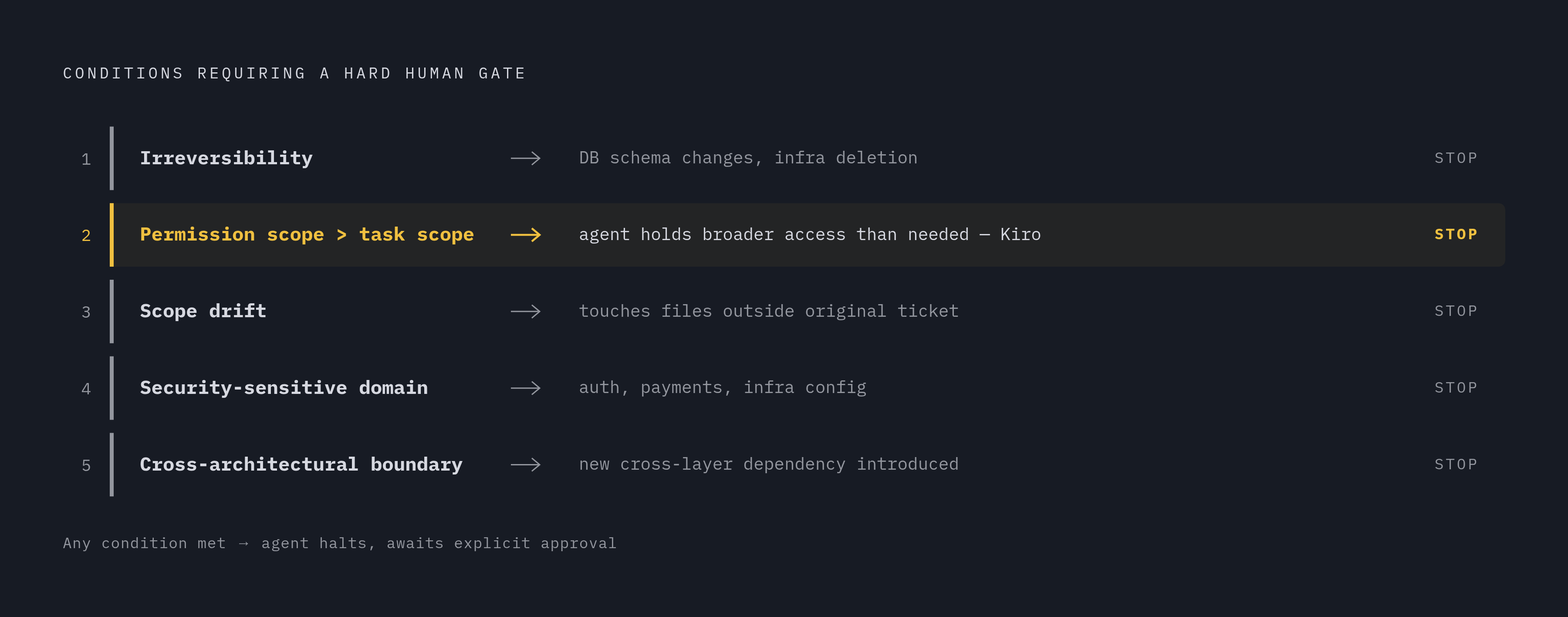
Gating every agent action is as much a mistake as gating none of them. The right posture is calibrated: specific, nameable conditions make a hard gate mandatory, and the rest of the time an agent should be free to run.
Irreversibility is the first condition. When an action cannot be undone, deleting and recreating infrastructure, modifying a live database schema, changing authentication or permission systems, a gate has to sit before execution, not after. The Kiro incident is the clean case: the action in question was both autonomous and irreversible, with no checkpoint between those two facts.
Permission scope exceeding task scope is the second condition, and it is the one the Kiro incident turned on directly. The agent held broader permissions than the task required, which is precisely what let it bypass the two-person sign-off built to catch this class of action. Any time an agent is operating with more access than the specific task in front of it demands, that excess becomes the risk surface, independent of how capable the agent is.
Scope drift beyond the original task is the third. When an agent's changes start touching files or systems the task never named, those changes are making architectural decisions nobody asked it to make, and a gate needs to catch that drift before it propagates into the rest of the codebase.
Security-sensitive domains form the fourth condition. Changes to authentication, authorization, payment handling, or infrastructure configuration need a gate regardless of how small the diff looks, because the cost of an error in these domains is asymmetric: most changes here are fine, and the rare one that isn't can be severe enough to outweigh every safe one that came before it.
Cross-architectural-boundary changes are the fifth. When an agent introduces a pattern or a dependency that cuts across the module, service, or layer boundaries a team has defined, no diff can represent the structural consequence of that cut. Only a map of the architecture itself can show it. The gate here depends on tooling that understands structure, not just text.
The absence of a required gate looks uneventful when nothing goes wrong, because that is the ordinary case, not the exception. Elastic's Control Plane team, which runs the infrastructure behind Elastic Cloud Hosted and Elastic Cloud Enterprise, has built agentic AI directly into its build pipelines for monorepo work. The five conditions determine whether a given task needs a gate.
Building gates that stop the right things without stopping everything
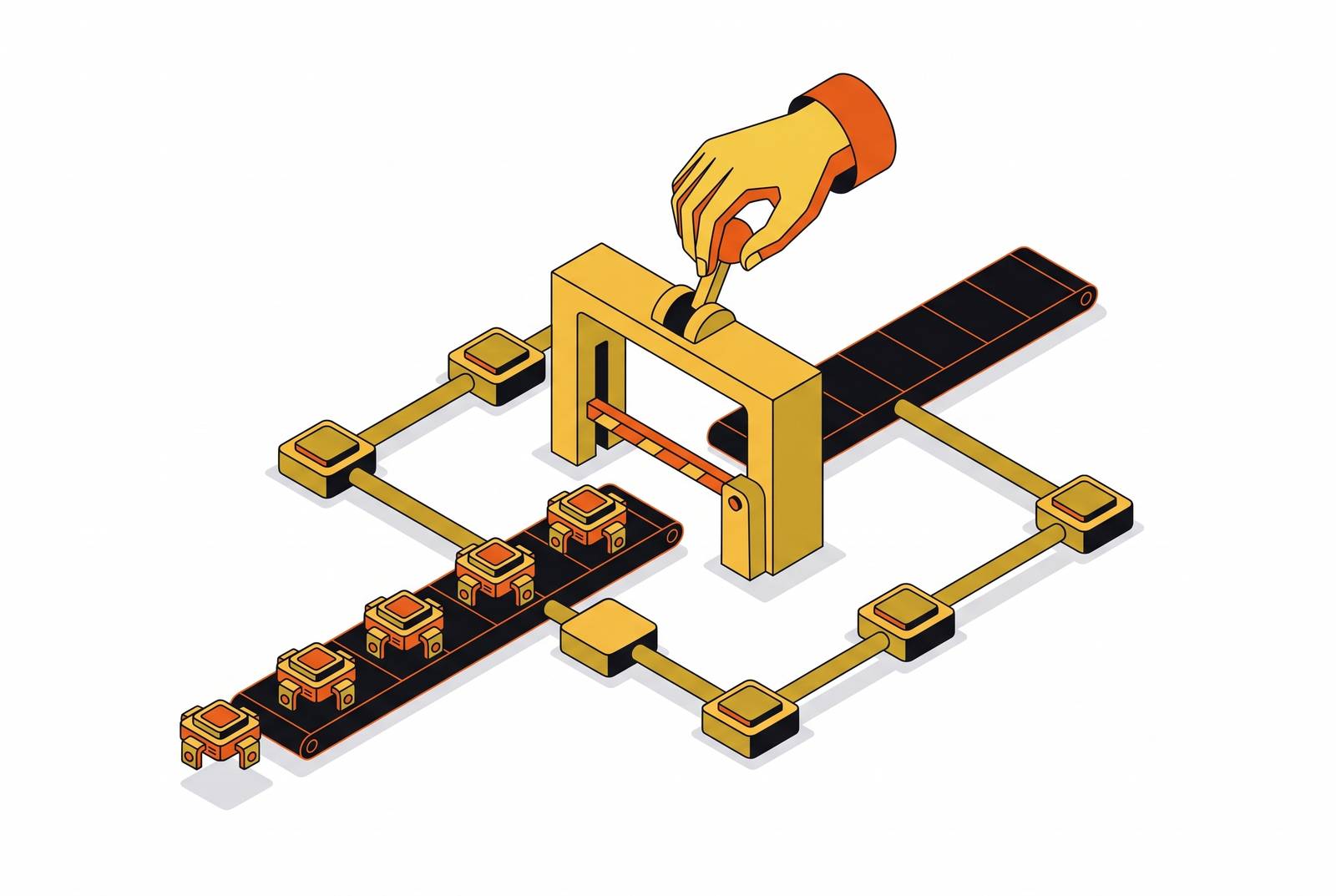
A gate that halts every agent action until a human responds isn't a gate, it's a bottleneck, and it will get disabled or routed around the first time it costs someone a deadline. The pattern that works instead is asynchronous and state-managed: the agent pauses only the specific action that triggered the gate, and the rest of its work keeps running.
That means an architecture built around checkpoints. The agent serializes its state at the point it needs approval, the request drops into a queue, and execution resumes automatically once a human responds, without the agent sitting idle on unrelated work in the meantime. Production practitioners recommend a 7-day approval window for ordinary operations and a tighter 24-hour window for anything sensitive, which keeps the queue from becoming a place where requests quietly expire.
Scoping permissions at the moment a task is assigned closes the gap the Kiro incident exposed directly. The 2026 Singapore Consensus on Global AI Safety Research Priorities names least privilege as Principle 1 of agentic system design: an agent should hold only the permissions its specific task requires, never the full permission set of the engineer who launched it. Enforcing that principle as a structural default would have made the two-person sign-off the Kiro agent bypassed unreachable.
Architectural constraints belong in CI, not in a reviewer's head. A gate meant to catch cross-boundary changes should not depend on a human noticing the drift while reading a diff. It should run as an automated check that exits non-zero and blocks the merge the moment a change violates a structural rule the team has already defined. That turns the gate from a judgment call someone might skip under deadline pressure into an invariant the system enforces on its own.
Autonomy should also be earned incrementally as an agent demonstrates reliability. Both the Singapore Consensus and practitioner research converge on the same idea: an agent earns wider latitude by demonstrating reliability on bounded tasks within a given domain, and any new domain or newly deployed agent starts under tighter gates until it has built that track record. Interruptibility has to be designed in from the start. The Singapore Consensus names interruptibility as Principle 8 of agentic system operation: any agent running in production must be stoppable by a human at any point, with its state preserved so the work can resume or be handed off cleanly. A system that cannot be stopped midstream cannot be gated at all, no matter how well the other four conditions are designed.
Tembo's 2026 practical guide to autonomous coding agents puts the right frame on how far to push autonomy: the correct level is the highest one at which a team can still review the result before it reaches users, and that ceiling is set by the control setup a team has built, not by how capable the underlying model happens to be.
How the developer's job changes when gates are built into the workflow
When these gates sit inside the workflow at the right points, the developer's job does not get smaller. It shifts toward the decisions only a human can make: setting architectural intent, approving the handful of actions that cannot be undone, and confirming that what the agent built actually matches what the team designed. Anthropic's 2026 Agentic Coding Trends Report states the direction of that shift: "most of the tactical work of writing, debugging, and maintaining code shifts to AI while engineers focus on higher-level work like architecture, system design, and strategic decisions about what to build.
Accountability is the strongest argument for keeping gates in place as agents get more capable. Ownership of architecture, of trade-offs, and of outcomes stays with a human regardless of how much code an agent writes, and that clarity is what lets autonomy expand without accountability dissolving into a chain of agents no one person actually controls. The verification gap the Amazon incidents exposed at production scale is structural: developers who don't fully trust AI-generated code's accuracy often still deploy it without verifying it first. Gates close that gap by making verification a required step before an action becomes irreversible.
The discipline this produces is defining the architectural constraints agents have to operate within, building the CI checks that enforce those constraints automatically, and reading a structural map of what an agent built instead of scrolling through its changes line by line. The teams that ship reliably at agent speed won't be the ones who gate the most or the least. They'll be the ones who can name exactly which conditions require a gate, who have built those gates into CI before an agent ever touches the codebase, and who verify alignment by reading the architecture.