Graph-Native Navigation as the Missing Primitive in Agentic Coding Stacks
AI agents need a shared graph to navigate code structure and honor architectural boundaries.
Sponsored by Graphide
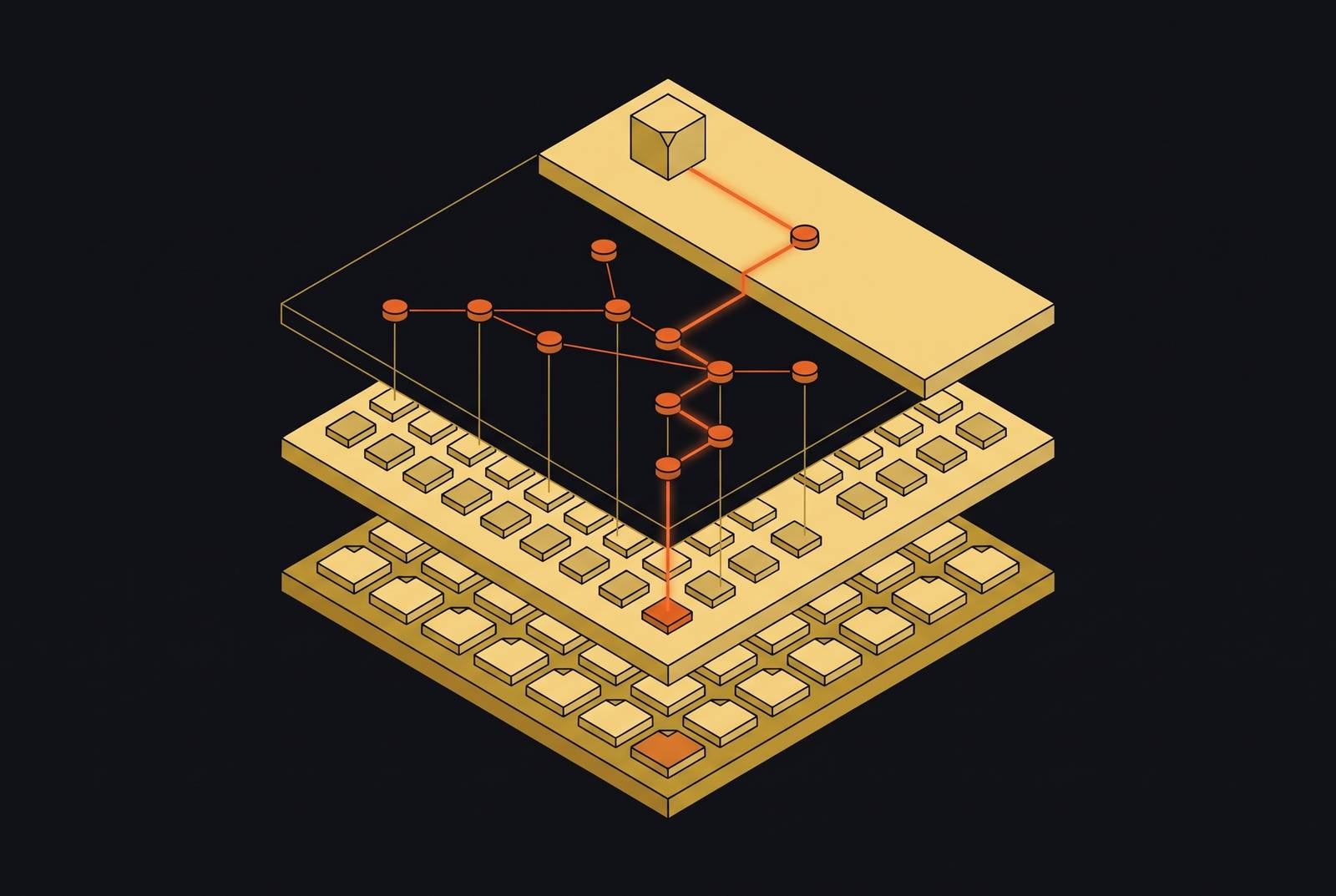
An interactive codebase graph for AI agent steering must give developers and agents a map of modules, dependencies, and call chains that they can share and query. Graph-native navigation is the primitive missing from agentic coding stacks because it lets an agent use architectural intent before it acts. Visual navigation needs to use the same structure to guide planning, set bounds on edits, and help with architectural review.
How agentic coding stacks have matured — and where they stopped
CLI-first agents, agents native to coding environments, and cloud-based asynchronous agents have converged on a sophisticated underlying architecture. Memory files, tools or skills, long-running execution, background agents, sub-agent orchestration, and repository awareness appear across these interfaces. The interface changes, but the execution model converges. These systems can keep working, hand off parts of a task, and work within approval gates as well as suggest the next lines of code.
Forrester’s The State Of Agentic Software Development, 2026 describes agents operating across analysis and planning, design, build, test, and delivery, increasingly orchestrated together. The Explore, Plan, Implement, Commit loop gives that broader capability a repeatable workflow. CI enforcement, PR review, sandboxed execution, and approval gates are established ways to keep that workflow in check. Yet repository awareness is not an architectural model. The shared stack still lacks a native representation through which an agent can navigate the codebase’s structure, despite having mature machinery for acting on what it finds.
What agents actually do when they navigate a codebase
Without a graph primitive, navigation falls back to grep, sequential file reads, and context reconstructed from the results. An agent searches for a name, reads matching files, follows references, and infers relationships from the material in its context. Its repository explanation reflects that recent reading. It does not have a persistent structural model against which to test whether the explanation is complete or the proposed edit stays within scope.
A flat file system gives the agent locations, but architectural relationships must be inferred from their contents. Explore therefore becomes a manual graph-reconstruction phase, conducted one file at a time. As the codebase grows, more relationships lie outside the files the agent has read, while more autonomy gives it more chances to act on incomplete context. When the session ends, the inferred structure is not preserved as a navigable architectural model.
The CMU/Stanford/Princeton position paper Humans are Missing from AI Coding Agent Research shows that patches made by agents are longer than gold patches even when the tasks succeed. Rising benchmark scores have not eliminated that patch bloat. In navigational terms, an agent that cannot verify structural reach lacks a reliable basis for deciding where its patch should stop, even when the resulting code passes the task’s tests.
Why structural blindness produces drift, not just bugs
A bug is a defect in behavior, while architectural drift is a deviation from the developer’s structural intent. A change can be locally plausible and still place a dependency across the wrong boundary or distribute responsibility incoherently. Passing tests does not settle that distinction. Without a declared architectural model, ordinary review tools have no structural reference against which to compare the change.
Dependency position also determines the risk of an edit. Foundation files sit at the lowest depth of the dependency graph, importing nothing while being imported by many other files. Their reach makes them high-risk places for structurally blind changes. Without a queryable graph, an agent cannot reliably trace that blast radius or self-triage its edit, and a reviewer faces the same reconstruction problem.
Meta’s RADAR paper, presented at ASE in October 2026, reported that agentic AI drove most of the growth in per-developer diff volume while fewer reviews were done on time. That finding establishes review pressure while leaving the causal role of graph absence unresolved. It nevertheless sharpens the operational problem of inspecting structurally opaque changes at increasing volume. AI-generated errors skew toward logic, dependency, and control-flow failures, which can look reasonable line by line. First-generation review tools that emphasize style over correctness leave those relationships insufficiently examined.
The steerability problem that graph absence creates for developers
For developers, the frustration begins with knowing the intended architecture but lacking a direct way to make it govern execution. They can explain a boundary in a prompt and inspect the resulting diff, yet neither the prompt nor the diff represents the boundary itself. The prompt expresses intent, while the diff exposes lines. Architectural decisions deal with modules, dependencies, and call chains, so the developer must keep translating between those forms throughout the task.
The position paper defines steerability as an agent’s ability to expose and respond to human control signals at meaningful decision points. It identifies failures of intent understanding and sustained control as growing obstacles to practical usefulness, rather than treating code generation as the only bottleneck. A shared graph gives those control signals a place in the structure to point to. Without it, instructions remain prose that the agent must interpret.
Forrester’s report describes architects and senior engineers focusing more on system design, constraints, and context engineering so that agents work within the right boundaries. That responsibility requires more than better-written prompts. The developer needs a machine-readable model that the agent also uses when deciding where to work and which relationships to change. Steering by prompt alone is like giving directions without a map, because following the words does not establish the direction of travel through the architecture.
Where graph-native navigation already exists — and why it hasn't crossed into agentic stacks
Joern, open-sourced by Qwiet AI, formerly ShiftLeft, produces a Code Property Graph that captures syntax, control flow, and data flow together. Security engineers use traversal queries to identify tainted flows, injection paths, and unsafe API usage across large codebases. The graph is an analytical substrate.
Serena gets a different kind of precision by using real Language Servers through LSP. Its open-source capabilities include symbol navigation, references, symbol-level editing, and persistent project memories. Backend choice limits the available structural views. Type hierarchy requires the paid JetBrains plugin rather than the open-source LSP backend, so symbol navigation should not be mistaken for an identical set of graph capabilities across both.
SciTools Understand combines code visualization, static analysis, advanced navigation, metrics, and graphical representations across multiple languages. It is deployed in safety-critical fields including aerospace, defense, and embedded systems, where structural analysis and coding-standard compliance have long been required. None of those capabilities, taken alone, establishes a shared architectural primitive throughout an agent’s execution loop.
Visualizations made for people and query results made for analysts need more work to become planning constraints a machine can use, and symbol-level tools alone fall short of graph-governed execution. MCP can deliver graph-enriched search, call-chain tracing, type-flow analysis, and blast-radius checks during a session. But transport is not the missing representation. No standard graph primitive has yet been established there to connect those operations into a common structural model.
What CI enforcement catches and what it structurally cannot
Architecture enforcement already has a useful set of steps from prose rules to configuration rules, lint rules, compiler errors, and structural tests in CI. Each step moves a constraint closer to a hard gate. Deterministic architecture tests prevent a build from passing when a declared rule is violated.
ContextCov, the research system described in arxiv:2603.00822, sends natural-language architectural constraints to enforcement generators that use graph algorithms on dependency structures. It can detect cycles, layer violations, and boundary crossings. This is a concrete prototype of graph-based constraint enforcement inside an agent’s CI loop. Its strength also identifies the limit, because detecting a declared violation is different from discovering the structural implications of a proposed change.
An agent still needs to navigate between the rules. Before editing unfamiliar code, it must understand what depends on that region and whether its plan crosses an undeclared boundary. CI cannot infer every part of the developer’s intent from the constraints already encoded. In a large, evolving codebase, uncovered relationships leave room for drift even when every declared check passes.
The OpenAI engineering team found that “agents are most effective in environments with strict boundaries and predictable structure”. Such boundaries make execution more reliable, but their existence does not make them navigable. A gate answers whether a change violates an encoded rule. A live graph also helps the agent determine where to act, what the change may affect, and which structural questions require attention before implementation.
Why graph-native navigation must be a first-class primitive, not a plugin
The operational requirement is to put graph queries before action and throughout the execution loop. A first-class primitive is infrastructure on which other capabilities depend. Planning, blast-radius estimation, constraint checking, and developer steering all need a way to use the relationships in the structure.
In this model, the graph lives in the repository, versions with the code, and remains queryable in CI. That places it in the execution path. A diagram consulted occasionally can describe an architecture, but a versioned graph connected to checks can also enforce declared constraints. The distinction is not whether the interface is visual, but whether agent decisions and merge controls use the represented structure.
MCP can expose the necessary operations without reducing the graph to a visualization. Agents can invoke call-chain tracing, type-flow analysis, module-boundary queries, and blast-radius checks during a task. Making those tools available is only part of the requirement. The workflow must require those structural checks at the points where exploration becomes a plan and a plan becomes an edit.
Developers must therefore focus their oversight more on constraints, graph-level changes, and which architectural moves to approve. The position paper identifies verifiability as a core interaction dimension, requiring outputs that people can inspect at a meaningful level of abstraction. Structural review gives people that level of abstraction when changes span files. Forrester’s call for end-to-end orchestration also strengthens the case for a shared model, because structural intent must remain usable across agents rather than be reconstructed independently by each one.
How do you give an AI coding agent a real-time codebase map in practice?
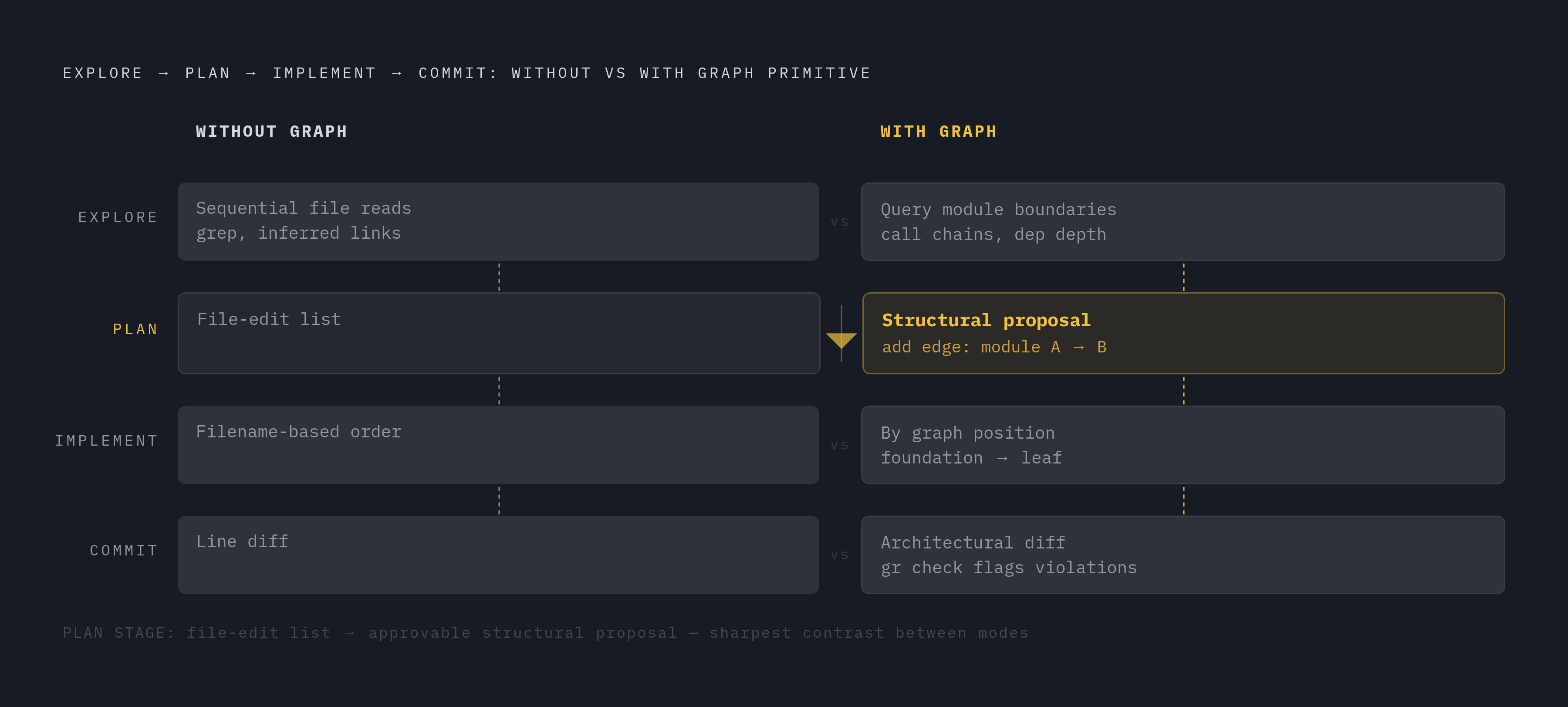
Plan becomes a set of proposals for changing the structure, such as adding an edge between module A and module B or adding a layer between X and Y. That gives the developer something architectural to approve. Instead of accepting a file-edit list and inferring its consequences, the developer can inspect the intended relationship changes before implementation begins.
The developer’s architectural review centers on what changed in the graph, instead of reconstructing the design from a line diff. That is the concrete criterion for an interactive codebase graph for AI agent steering. The human and the agent must navigate the same model, and that model must influence action before the patch exists. Otherwise, the stack has acquired another view of the code without acquiring control over its structure.
Putting architectural checks in CI
Choose an architecture-test or dependency-rule tool that supports your language and the constraints you can explicitly encode. Commit its rules with the code, run the documented command in CI, and make the resulting check required where those rules should prevent a merge. Test the gate with an intentionally forbidden dependency before relying on it. Such checks enforce the rules you specify; they do not establish that every aspect of the architecture or runtime behavior is correct.
Updated November 5, 2026: obsolete CLI examples removed. Use the selected tool’s current installation and command documentation.