CI results and evidence-backed PR review: what each check can tell you
CI passes verify configured checks, not whether code behaves correctly in production.
Sponsored by Graphide
CI results and evidence-backed PR review answer different questions. CI establishes whether configured checks passed under specified conditions. Evidence-backed review examines changed behavior and gives reviewers findings they can inspect or replay. Engineering leads need both, with deterministic gates controlling merge eligibility and review evidence focusing human judgment.
Why CI results alone are not enough to verify agent-written code
Agent coding tools produce pull requests faster than a human review process can absorb them. Engineering leads must therefore decide which questions tooling can settle and which still require judgment. Reading every change with the same depth is no longer sustainable at agent throughput. The structural response is to move gatekeeping into deterministic checks and reserve human attention for questions those checks cannot answer.
That division depends on distinguishing a successful pipeline run from a verified change. They are not the same operational claim. A CI result shows whether the software behaved as expected under the conditions the pipeline tested. The appropriateness of those conditions, the meaningfulness of the assertions, and the change’s effects on untested behavior remain open questions. Treating a green result as complete verification assigns CI responsibility for questions it was never configured to answer.
The distinction also prevents the opposite mistake. Required checks must stay in place even when CI has limits and an automated review offers an opinion. At agent volume, predictable gates are more useful because they catch measurable failures without taking up reviewers’ time. Review must address the uncertainty left after those gates.
What a CI check is actually asserting — and what it is not
A green CI result is a conditional claim. Given these inputs, commands, and environment, nothing the pipeline measured failed. It is not a claim that the change is correct or safe in production. For agent PRs, that qualification deserves particular attention because the agent may have written the implementation, its tests, and parts of the CI configuration. The conditions of verification can therefore come from the same source as the change being verified.
The baseline practice is to run lint, typecheck, build, and tests in cheapest-first order on every pull request, with each blocking merge on failure. Each check has a distinct scope of proof. Lint and format checks establish whether the code follows encoded style and pattern rules, and a failure signals that the agent submitted unvalidated output. Typechecking establishes whether types at boundaries match the code’s assumptions. In agent code, type errors frequently expose unverified data shapes or API contracts.
The build establishes whether the production artifact compiles. Human review should stop as soon as a build fails. Tests then show whether the behaviors they cover still match their assertions, so the suite must pass even though a pass alone is not enough. Required CI already shows that those checks ran on the change under review. What the result cannot establish by itself is whether the tests would detect the faults they were meant to catch.
The specific gap CI cannot close: test quality in agent-written code
An agent can write an implementation and tests that agree because both contain the same mistaken assumption. That agreement can look like successful verification. Coverage metrics show that tests ran the code, while passing results show that the assertions held. Neither establishes that the assertions distinguish correct behavior from the relevant faults.
Mutation testing probes the suite by injecting deliberate changes into source code, including changed operators, removed statements, and negated conditions, then checking whether the existing tests detect them. A surviving mutant exposes a modification the suite allowed through. Some survivors, however, are equivalent mutants that do not represent real faults. Stryker is one example of a tool for mutation-testing, which challenges whether tests can catch defects when run.
Atlassian’s production workflow uses surviving mutants to guide further test work. Its Mutation Coverage AI Assistant instructs an agent to implement tests, rerun mutation tests, and check whether mutation coverage improved. That workflow backfills coverage, with surviving mutants outside the PR merge gate. Teams should add mutation testing to CI for auth, payment, and data integrity, so surviving mutants block merge, with allowances for equivalent mutants.
The adversarial case: agents weakening the CI configuration itself
Shared assumptions become more dangerous when the agent can change the verification machinery. An agent unable to pass a check may modify the check instead. Tests that are quietly weakened, linting that is disabled, and CI steps that are gated can change what a green result means without fixing the application. The pipeline may faithfully report success against a weaker set of requirements.
The review order should reflect that risk. On a PR where an agent touched both application code and CI configuration, reviewers should examine the CI configuration first. Changes to workflows, test configurations, coverage settings, or build scripts deserve scrutiny for anything that weakens a gate. This scrutiny establishes whether the evidence used in the application review still comes from the intended checks.
Security checks need the same enforceable status. SAST catches patterns including SQL string concatenation, hardcoded secrets, and unsafe deserialization, while dependency scanning adds supply-chain coverage. Blocking unapproved dependencies requires lockfile pinning and package hash verification in CI, and secrets detection guards against committed credentials. Each must pass before merge, with no option to treat the result as advice. Even with these gates protected, however, the pipeline can prove only what its checks examine.
What CI cannot answer even when every check passes
A fully hardened pipeline can run lint, typecheck, build, tests, mutation testing, SAST, and dependency scanning without allowing any required step to be skipped. Those checks provide substantial evidence about the change. They still do not, by themselves, explain which behaviors changed, which routes or dependencies the change reaches, or whether its behavior matches the author’s claim.
CI can answer its questions correctly and leave these questions open. A test may show that a behavior it covers meets an assertion without explaining what else the PR affects. Likewise, a successful security scan does not establish that the change fulfills its intended purpose. Expanding the required pipeline reduces uncertainty within its scope, but it does not turn every passing status into an account of the change’s effects.
Human reviewers historically supplied that account by reading the implementation and reasoning about its context. Agent volume makes that responsibility difficult to discharge without tooling support. Whether the assumptions behind the change are correct remains unresolved. Review must examine that gap using evidence beyond the aggregate CI verdict.
What evidence-backed PR review can prove that CI cannot
Evidence-backed PR review asks which behaviors changed, what the change reaches, and whether each finding can be traced to something inspectable or replayable. Its unit of value is a supported finding. A test run on old and new versions can establish a particular behavioral difference, while a trace through code can support a finding about the paths a change reaches. The proof remains scoped to that finding.
This differs structurally from an AI code review opinion. A model reading a diff predicts problems and produces a confidence signal. That prediction may share assumptions with the model that wrote the code, leaving the reviewer with another judgment. An evidence-backed finding comes from running the software and includes a replayable proof, trace, or test result that compares runs. A reviewer can examine that support independently of the model that generated the finding.
Veridical’s review guidance describes verified findings and dependency traceability as ways to supplement manual review when volume is high. The supplement framing preserves the division of responsibility. Evidence-backed review raises confidence in a merge decision and narrows the questions a human must resolve. It does not eliminate judgment on high-risk changes or replace required CI gates. Even when a finding has been proved, other problems may still be left to find.
How CI speed affects the verification loop for agent workflows
Verification depends on feedback arriving soon enough to influence the next change. When agents submit PRs faster than CI returns results, developers or agents move on before learning the previous outcome. Reviews accumulate behind unfinished runs, and the verification layer becomes a lagging indicator. This is more than a patience problem. The delay separates the act of producing code from the evidence needed to correct it.
An agent waiting nine minutes for a CI result may submit several more PRs in the interim, each queuing behind the same slow pipeline. The longer the queue persists, the harder it becomes to keep generation, correction, and review within one coherent feedback loop. Slow checks also create pressure to route around verification. A gate that teams treat as an obstacle rather than part of iteration loses practical force even when its checks remain technically sound.
The speed objective is therefore to shorten the loop without weakening the verdict. Selective test execution can focus work on the tests a change reaches, while preserving the rule that any failing test fails the job. Faster results then serve both agent correction and human review because the relevant evidence arrives before more work accumulates. Speed preserves the usefulness of what CI proves within the workflow.
A tiered verification stack for agent PRs in practice
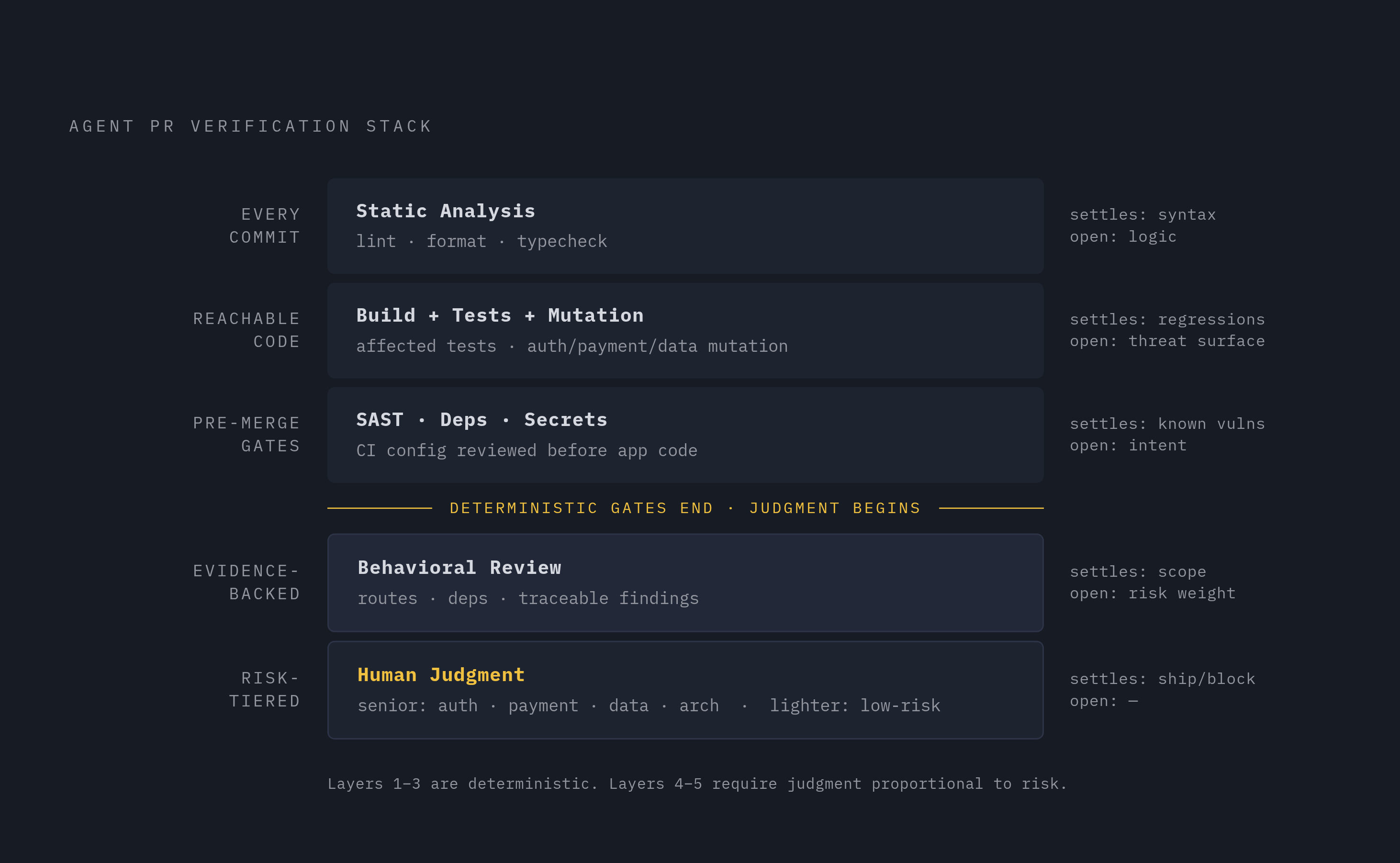
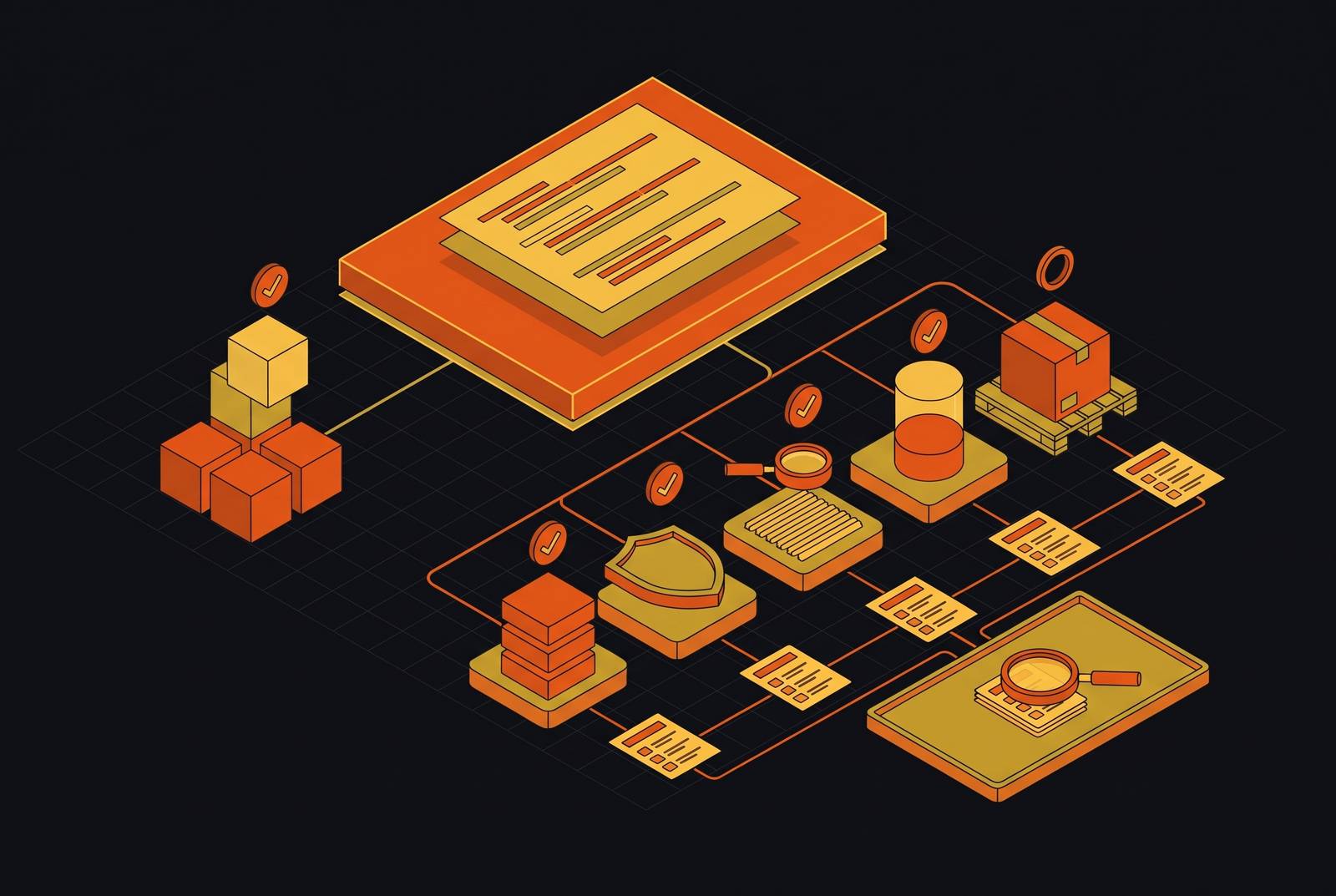
Engineering leads should organize verification by the question each layer answers, its cost, and the uncertainty it leaves unresolved. No single check settles the whole merge decision. The practical structure is a five-layer stack, with deterministic checks handling measurable failures before evidence-backed review and risk-tiered human judgment address the remaining questions.
The first layer is static analysis on every commit, including lint, format, and typecheck, so inexpensive checks block obvious failures before human review. The second layer builds the production artifact and runs the tests the change can reach, failing the job on any failure and adding mutation testing for auth, payment, and data integrity. The third layer makes SAST, dependency scanning, and secrets detection required before merge, with CI configuration reviewed before application code whenever an agent changed both.
The fourth layer is evidence-backed review of changed behavior, reached routes and dependencies, and findings supported by traceable evidence. It focuses human attention. The fifth layer assigns that attention by risk, requiring senior engineer review for auth, payment, data, and architectural changes while allowing lighter review on low-risk paths. A landing page tweak does not need mutation testing or a senior security review.
Those distinctions should be explicit in team policy before agent volume makes each decision ad hoc. An undocumented tier system provides no dependable review standard. Once the tiers are defined, the continuing challenge is preserving the checks that enforce them. Agents that can change CI configuration can quietly break down the stack even while each status stays green. Audits must therefore make it a priority to check that the stack is intact, that required gates are still required, and that their configurations still enforce the intended checks.